Your link actually proves the OP right and you wrong. Look at the graph of the running average of GDP and you see that after a huge spike in the 40s (due to the WW2 effort) GDP growth settles on a new higher average (with significantly less fluctuation).
The spike in the 1940s is the war itself and recovery from the Great Depression. Obviously NATO and the reserve currency and whatnot came after that spike. If you look at the second chart, we’re right around the same point as the historical 1.7% growth curve. If you look at the fifth chart, the large european economies also seemed to have grown slightly faster after the war than before it. So I’m not sure how much the U.S. is benefitting from being the hegemon.
The real reason the U.S. is so rich is that it was already the richest country in the world in 1900. The U.S. had almost 50% higher GDP per capita than western europe in 1900: https://www.researchgate.net/figure/Population-GDP-and-GDP-p.... Today, its still about 50%.
> If you look at the fifth chart, the large european economies also seemed to have grown slightly faster after the war than before it. So I’m not sure how much the U.S. is benefitting from being the hegemon.
Nobody's denying that the US-created world order has been good for its partners but that doesn't mean the benefit was at the US's expense. International trade is not a zero-sum game - the lifting tide and all that.
The post I was responding to implied that the U.S. enjoyed a special benefit from being the one maintaining the hegemonic world order: “The US's expenditure on its military was never to protect anyone from the Soviets but to impose its own world order against the Soviets, it's been always self-serving.”
If the U.S. obtained such a special benefit, it should have grown faster than western europe from 1950 to 1990, but it didn’t. If that growth comes from peace, not being the hegemon—as you put it, a rising tide lifts all boats—then the U.S. is disproportionately bankrolled a peace that western europe equally benefitted from.
Part of the story here is that international trade just isn’t that important to the U.S. 90% of U.S. GDP is domestic. Just 1.1% is exports to Europe.
> If the U.S. obtained such a special benefit, it should have grown faster than western europe from 1950 to 1990
Not necessarily; the US could have extracted that benefit by staying ahead of the rest of the world in terms of its citizens' wealth, with all the benefits this entails.
We can't know the "what-if" (would the US have become even richer by being an isolationist MAGA dreamland), but we know for a fact that the world order was created and maintained by the US, so it must have had its benefits all this time.
That’s possible, but it’s a much more uncertain claim than the one being made above. The US became 50% richer than western europe by being an “isolationist MAGA wonderland” before reengaging with the world during the wars.
Did hegemony help the U.S. maintain that edge? Maybe! But I think that’s a harder claim to prove than suggested by OP. I think the direct cause of America keeping its edge in the second half of the 20th century is we have Silicon Valley. I can think of a mechanism how reserve currency status is an indirect cause: reserve currency status means the world invests in American banks, and banks then use that money to fund tech startups. But is that really what’s happening? As I said above, I’m unsure.
Reserve currency status makes increasing money supply easier (the US has run large deficits and monetary expansions with less inflation than peers). "Petrodollars" create persistent demand for USD, independent of US domestic conditions - countries that import oil must earn USD (via exports, borrowing, or reserves) or hold US reserves in advance. Oil exporters, on the other hand, invest surplus dollars into US treasuries. This process absorbs US money creation and lowers US borrowing costs. This is an enormous advantage that the US is likely to lose if it continues on its isolationist course.
Why are people arguing that icons should be intuitively tell you what the app is about? Since when was that the goal of an icon (in paritucal an app icon)? It should be easily distinguishable from other icons. If I don't know what the icon means it will take me exactly 1s to find out by clicking on it, after that I will know what the app icon is for, and I only care if I can distinguish it easily from other icons, so I don't accidentally start a different app.
I strongly agree. But (having just replied to someone else about ideography) it leads to an interesting thought. Once you learn them the app icons become a shared legible writing system. Going to drive to the store? Go lang, Google Drive, Play Store. You get the idea.
It's a trademark violating abomination but I think we ought to give it a try.
But... your point is valid. I didn't interpret the original comment as being limited to app icons, but on another read you are right; it does emphasize them.
Apple's guidelines have long been flouted by Apple itself, not to mention that they're replete with stupid ideas.
I've developed a few iOS apps, and one of my favorite Apple "guidelines" (which they essentially enforced at the OS level without developer choice) was that, upon launch, your app should show a fake UI while doing startup tasks in the background. The recommendation was part of Apple's admonishment against splash screens. Think about how dumb this is, and how it makes your app look inept. Apparently plenty of developers did, and shunned this dumb idea; because Apple then forced it on developers whenever technically possible.
Upon your app going into the background or being kicked out of memory, Apple will take a screenshot of what your app is showing. When the user returns to your application, Apple will present this old screen shot; but none of the controls on it will work. The user can tap away furiously, but nothing will happen. When the app returns to functionality, the screen will be replaced by the real UI.
The problem here goes beyond ineptitude into a major privacy issue. You can think you "closed" or changed what an application is showing before handing your device to someone, only to find that Apple still shows a screen shot of its old contents in the open-apps stack. This could be a disaster.
Sure, NP. Not attacking you at all. Just Apple's hypocrisy.
But all of Apple's UI missteps probably don't compare with the festering rot of glaring incompetence that has destroyed Windows and Office in this millennium alone.
Yes, was very fortunate to ditch windows decades ago. I've heard to latest iterations are atrotious.
And I agree with you about Apple's hypocrisy. They often have one set of rules for themselves that is very different than the set of rules they apply to others.
Atrocious is the word. It's incredible how much time in my day is wasted just hunting for shit in Explorer, scrolling through screen after screen of redundant shadow copies of my user directories... many of which are "prohibited." Or bringing my Explorer windows back to the foreground.
Or trying to make fonts work.
Apps now lack menus and title bars. it's often impossible to tell what app a window belongs to! WTF? Critical functions are now buried under hamburger buttons all over the place.
The File dialog in several apps (notably Office) has been replaced with a bizarre full-page text-based mess, which doesn't show where you are or let you navigate the file system to where you want to be.
This is one thing that I don't understand, take for example Germany, the population barely grew over the last 20 years [1], at the same time there has been a building boom that building costs have risen dramatically (more than doubled between 2010 and 2024). Compare that to the 60s and 70s where population was rising much faster in combination with the rebuilding effort. So is the growth of housing stock lower than the population growth? If yes how come that this was not the case when population growth was significantly faster (even 30 years ago). I don't recall there being more building going on when I was young than now, in fact if anything my impression is it's the other way around.
This apparent conundrum breaks away if you consider who holds the wealth now vs. in the 60s. In the 60s-70s, there was a wealth tax in Germany. Shortly after WW2, a law was drafted to redistribute wealth: All individuals and companies whose assets remained largely intact were required to pay 50% of their net wealth (as assessed on the day of the 1948 currency reform).
This means that the working class had immense wealth and so simple jobs could support a family on a single income, buy a house, etc.
Compare that to today — the two richest families in Germany hold more wealth than the bottom 50% COMBINED.
It is no wonder that normal families cannot afford to buy property anymore; and are forced to rent. This further exacerbates the wealth gap.
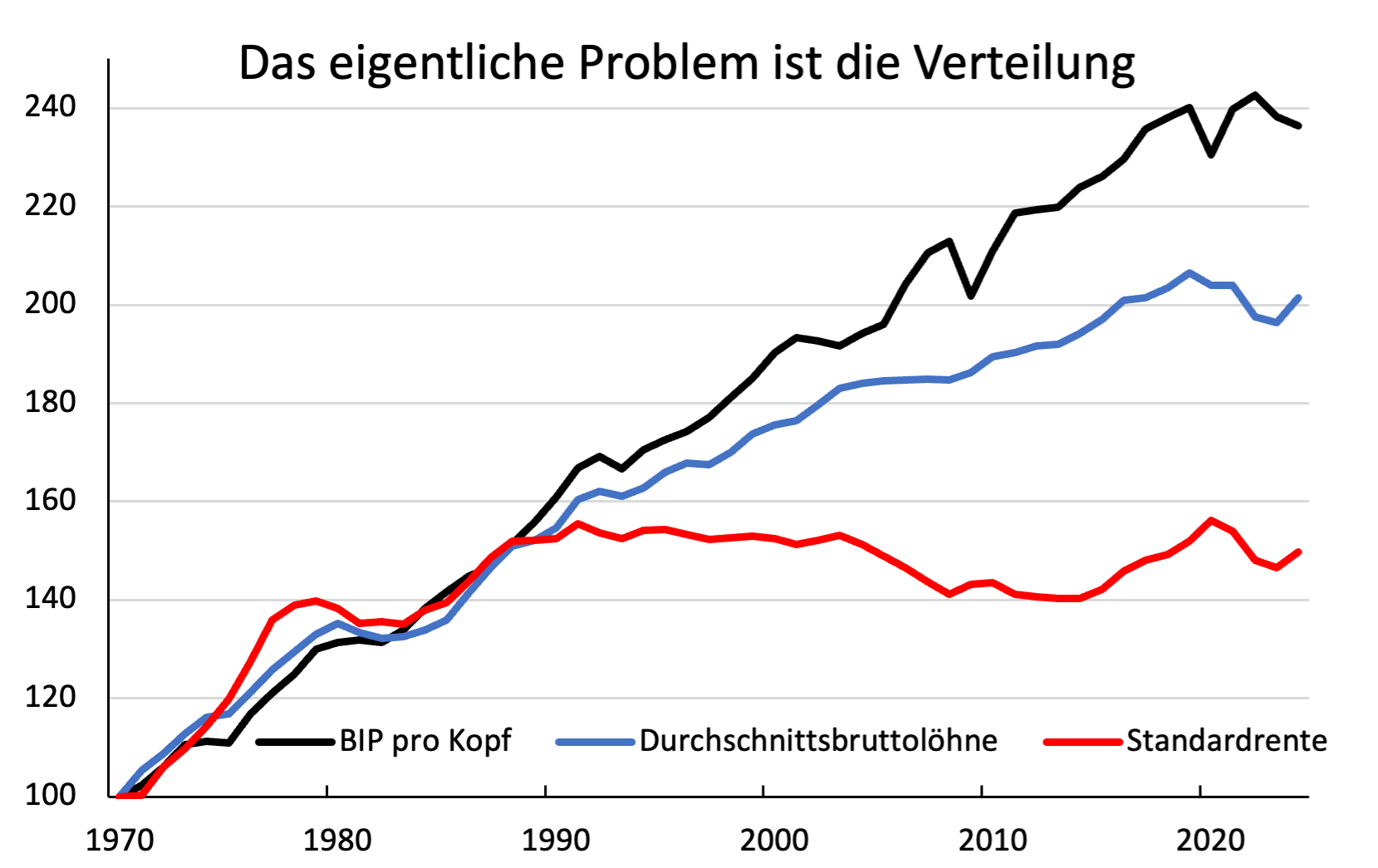
(Black line - GDP, blue line - avg comp; red line - avg pension)
In short - the productivity increased; but ordinary people are being squeezed out of the gains regardless. No wonder that everyone turns sour at some point.
1) the 50% net wealth tax vis-a-vis 1948 currency reform?
2) which 2 richest families in Germany hold more wealth than the bottom 50% combined?
3) most wealth distribution plots I have seen show a significant negative start (people in debt) then a large number of people with effectively 0 net wealth (what is earned is spent) and then a rise towards the haves. From such plots for different nations I am not surprised that the lower 2 digit percentages effectively have net 0 (with those in debt balancing those having a mediocre surplus), so it would seem trivial for this factoid to be true in many nations (with a slight change of the 50% number or a slight change of the exact number of richest families)
The perspective you give is certainly remarkable in the sense that the Nazi rise was basically a counterreaction to the rising popularity of communist ideas, with the end result... a redistribution of wealth after all, not even a holocaust could stop the wealth redistribution.
3) theoretically people could own via the state: if the state has resources (eg. hospital buildings, schools) that benefits all people ~uniformly. However, due to privatization more and more government wealth is also sold off.
Wealth redistribution is the only way the living standards of ordinary families will improve. I’m just hoping we can skip the war part, this time. I think its possible.
> So is the growth of housing stock lower than the population growth?
National averages can hide a lot of local issues. I'm in Berlin right now, I'm told by locals that it's lost the reputation it used to have for "cheap" housing. (It's not cheap, but I'll have to take their word for it that it ever was, I've not found historical purchase prices vs. income graphs like I've seen in the UK).
New places are more expensive for various reasons. The land in Berlin can easily be as expensive as the cost of building a home on that land, because fixed supply and a lot of demand. Even if the land was free, the cheapest new build cost I've seen is more than twice the price of the more expensive of those two, but will almost certainly also make up for the full price difference (including land at Berlin prices) just in reduced energy bills before the mortgage is paid off.
I suspect part of it is that the housing being built now is both bigger and better than that built in the 60s and 70s. Think of what cars were like then versus now. The other might be the availability of land. Another factor is how housing has changed from being more of a commodity item back then (its a place to live) to an investment vehicle (its a thing you own and make return from). These trends are not specific to Germany, but would apply to many developed countries worldwide.
Excellent question, what happened is there are less people in a household than there used to be and households consume more m2 per household member. In reply to your second point, percentagewise there has been less building, in absolute terms there is more because of population growth since the 60s. This translates to ‘seeing more building projects’.
IMHO the key problems is new building is not targeted to the affordable market and easier to build areas with access to jobs of good economic income are not really open any longer. The established land markets are more expensive because literal "green field" expansion of new cities is not very common, and no longer available in quantity. The cost to build are further increased because the higher end market demands more amenities and developers almost always target the highest market available.
Note: I have a personal theory that one way China was able to perform at this it's current stage of growth, was because it was expanding a lot of first generation real estate development to new areas. It will be very interesting to see if they are able to maintain low housing costs going forward into the next couple decades.
There are dubious claims that the lower end market will be served by aged-out high end market housing and that's simply not the case. It ignores that housing stock ages out of usability - and remodeling is often more expensive to work on than the initial builds. Once you remodel them, they occupied at the high end, then they never free up or go down in rent for other portions of the market.
Not German so I can only talk about how it is going in another country:
- Massive change in the average household size: way fewer people live together now (delayed couple & family formation, divorce, etc.). If you go from 4 people per household to 2 people per household, now you need twice as many homes.
- Massive internal migration: declining population in a lot of rural areas and increasing in cities & their suburbs. So lot of empty houses and super cheap houses in Dumbfuck, Nowhere but scarce & expensive homes where people want to live.
There is also the problem of housing "lost" to the lifestyles of the well-to-do - whether that's 1%'ers who own multiple houses, or regular housing which becomes short-term rentals (Airbnb or whatever). In places, those are major problems. Overall - the biggest problem those cause might be that they're socially divisive distractions from bigger issues.
Yes completely agree. I always hang up my washing (also in NZ, don't have a dryer) and was recently sorting through my tshirts as we are moving country. I have one t-shirt that is nearly 20 years old and still holds its shape (though the color and print has faded) on the other hand i threw away a bunch of other t shirts which were just over a year old because they developed holes and particularly the collar is completely broken. Funnily their color and print is mostly fine.
I don't think brand is a good predictor either, e.g. the old t shirt is from threadless IIRC while I had many other threadless tshirts which didn't last near as long.
Not sure I understand your point. In the plot you mention what the OP said certainly holds true for China and Europe (less so for the US). Also the Charts plot investments not just new capacity investments, I'm not even sure how you distinguish between the two?
The OP said new carbon sources are not competitive.
ANY investment is by definition creating capacity that would not be there without the investment. If carbon were not competitive it would not get investment.
If you sum up all of the carbon and compare to renewables in the chart there's more new carbon investment annually globally than renewables. (Comparing the dark lines vs the green line)
Also this is ignoring "low emission fuels", which are still carbon sources, natural gas and the like.
If you check the chart "Global electricity generation of zero-carbon sources vs. fossil fuels, 2000-2024" you can see that carbon sources were at an all time high in 2024. Growing slower is still growing.
We ought to be shrinking these to zero. I'm very glad to see solar and wind growing but my point is nuclear is worth supporting as an non-carbon energy source that could replace some of this carbon load because of its baseload characteristics.
"Global investment in clean energy and fossil fuels" shows a decline in fossil.
And there are plenty of good reasons why the investment in fossil fuels is still there because these investments can easily be not because its is still competitive, but its still competitive because base costs have been written off.
Aka the replacment of that coal power plant might have been 'competitve' because the whole infrastructure around it is still there and usable, because they might just replace the main burning chamber. Because for current stability reasons its easier to add gas turbines or keep them alive as backup because the renewable energy build out takes more time.
Nonetheless, the overall statistics says that renewable + batteries are now the cheapest energy source on the planet. Locally it might not be doesn't change the fact.
And no we do not need nuclear for baseload. Wind and solar are capable of baseload.
Alone my 4 year old EV has a batterie of 100kWh which would allow a heat pump to heat a house for 2.5 days.
Also countries in the north like Canada has plenty of waterenergy for baseload and countries closer to the aquator have extreme amount of sun.
Earthenergy can be still used in the most northern countries.
Even China who committed to significant nuclear capacity and wanted to ramp up their nuclear percentage to 20% (IIRC) is slowly moving away. The percentage of nuclear has in fact reduced over the last 5 years and initial commitments/projections of nuclear capacity are likely not going to be med. The whole reason being that solar (and to a lesser degree wind) have become so cheap that nuclear just doesn't make economical sense even for China.
> Am sure you're already aware, but for others in the thread:
>
> Absence of titles does not mean absence of hierarchy. Absence of formal hierarchy doesn't mean absence of social power.
>
> At their best, flat hierarchies do as described.
>
> At their worst, they take on all the worst aspects of cults together with all the worst aspects of high school. Endless manoeuvring for influence, currying favour, autocratic fiefdoms emerging without people having the mental framework to even identify that they exist.
>
> Humans are complicated, and we do seem to have a certain amount of low-level social wiring for hierarchy and pecking order, even if it's far from absolute.
>
> I don't know how this applies in the context of Toyota, but there are plenty of places where pushing the Stop button - while formally permitted - has a social cost such that only a certain few are effectively given permission to do so; large amounts of energy are expended either attempting to belong to that few, or currying favour with them. Power tends to accrue to those most inclined to seize it.
>
> Whereas in a more formal org, people with "manager" in their title are at least subject to a minimum amount of vetting, training and oversight.
>
> TLDR, flat hierarchy can be better than rigid hierarchy, but nominally "flat" hierarchy with power-gradient characteristics can be the worst of both worlds.
> Am sure you're already aware, but for others in the thread:
>
> Absence of titles does not mean absence of hierarchy. Absence of formal hierarchy doesn't mean absence of social power.
>
> At their best, flat hierarchies do as described.
>
> At their worst, they take on all the worst aspects of cults together with all the worst aspects of high school. Endless manoeuvring for influence, currying favour, autocratic fiefdoms emerging without people having the mental framework to even identify that they exist.
>
And that is different from more hierarical organisations how? I mean there are plenty of stories about infiting, thiefdoms, manuvering... in hierarical organisations as well. There's also lots of example we're the disconnect between the top and lower tiers of the hierarchy (i.e. the essence of the hierarchy itself) let to the downfall of the organisation. I also fail to see the connection to the article, the organisation did not seem to have failed (in the view of the author at least), due to the failed "democratic" organisation experiments, but due to the leadership in the current hierarical organisation not listening to the "lower tiers". So if anything it seems to be a problem of the hierarical structure.
> Humans are complicated, and we do seem to have a certain amount of low-level social wiring for hierarchy and pecking order, even if it's far from absolute.
>
I dislike these generalised statements about "human nature", there is way too much uncertainty and plenty of counter examples.
That said I agree with some of the other points you made, the post reads a bit weird considering that the author essentially gave up his ability to influence the course of the organisation (both by giving up his leadership seat, but also before by disenganging from the process), and the complains that the organisation did not develop how they wanted.
The difference in a hierarchical org is that the structure is laid out on paper for everyone to see. The power dynamic is explicit rather than implicit.
(At least, it's supposed to be. You do get weird inversions from time to time, when a weak manager is put in charge of a domineering empire-builder, but it's rare - and even in that case, the rest of the org can see the anomaly - as they have a frame of reference to measure it against.)
"Humans are complicated" => that is my uncertainty caveat. We're not absolute-hierarchical nor absolute-flat, in much the same way as we're neither exactly chimp-like nor gorilla-like in terms of monogamy. My observation though (and hardly an original one) is that when we build organisations which try to deny hierarchy, it has a habit of sneaking in thru the back door.
There are more differences: A formally structured org isn't a flat org with titles attached.
> "Humans are complicated" => that is my uncertainty caveat. We're not absolute-hierarchical nor absolute-flat
yes
> when we build organisations which try to deny hierarchy, it has a habit of sneaking in thru the back door.
The same happens when we try to deny freedom. Empowering everyone, through freedom and universal equality and human rights, is the foundation of the very successful modern world.
As I said upthread, I think the focus on hierarchy and power is really an outgrowth of current anti-democratic politics, even if people don't explicitly think of it that way. That doesn't deny all hierarchy or power - it's a matter of degree: The history of modern democracy is to lean heavily toward individual freedom (for essential moral reasons too).
I think the difference between sycophancy and NVC (at least how I learned it) is that a sycophantic person just uncritically agrees with you, but NVC is about how to communicate disagreement, so the other person actually listen to your argument instead of adopting a reflexive defense response.
I think the problem is that telling someone they're wrong without hurting their ego is a very difficult skill to learn. And even if you're really good at it, you'll still often fail because sometimes people just don't want to be disagreed with regardless of how you phrase it. It's far easier for the AI to learn to be a sycophant instead (or on the opposite side of the spectrum, to learn to just not care about hurting people's feelings).


reply